An extended account of a public life, written as a continuous narrative rather than a
list of offices. Roughly a twelve-minute read.
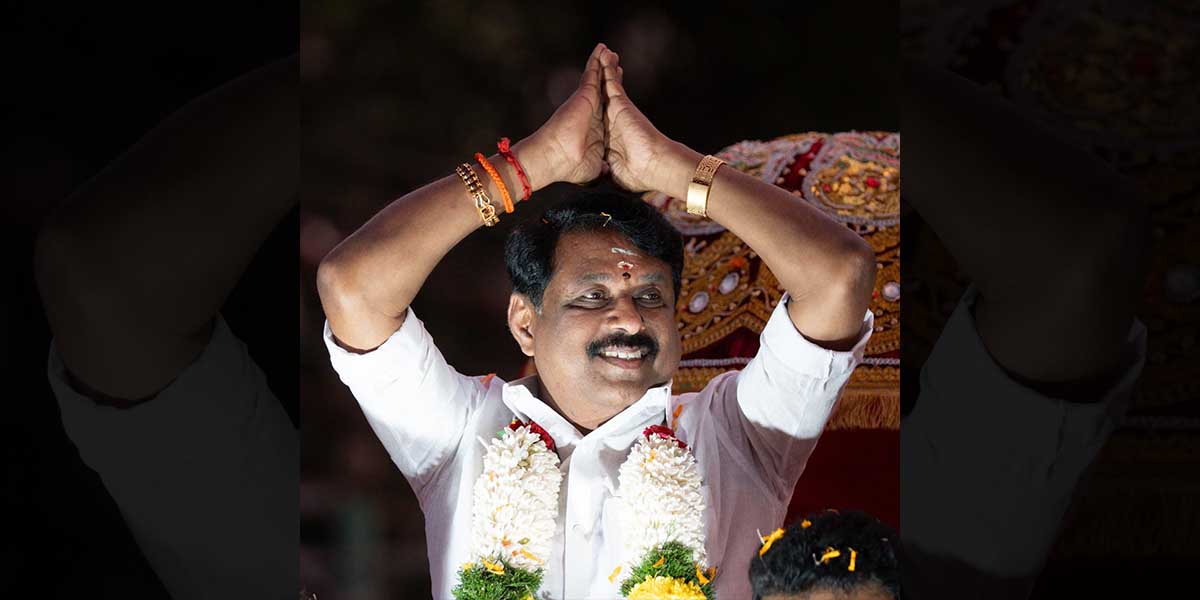
Garlanded at a night-time public reception — the form that political welcome most
often takes in the Tamil districts.
I
Vadiveeswaram and the South
Nainar Nagendran was born on 16 October 1960 at Vadiveeswaram, in what was then the
Madras State of newly independent India. The southern tip of the Tamil country in
those years was a landscape of temple towns, river-fed agriculture, mission schools
and colleges founded in the nineteenth century — and of a politics already
organised around the Dravidian movement, which would take power in Madras State
within seven years of his birth and never fully relinquish it.
He grew up into that settled political geography rather than making it. By the time he
was old enough to vote, Tamil Nadu's two-party rhythm — DMK and AIADMK,
alternating in and out of office — was already established. National parties
were present in the state, but rarely decisive. Anyone entering public life in the
far south did so inside that arrangement.
His education was entirely local. He took a bachelor's degree in commerce at
St. Xavier's College in Palayamkottai — the college town that sits across the
Tamiraparani river from Tirunelveli proper — and then a master's degree at
M.D.T. Hindu College in Pettai, on the Tirunelveli side. Both institutions are part
of the same small academic corridor. He was formed by the district he would later
spend twenty years asking to elect him.
On place names
Tirunelveli, Palayamkottai and Pettai are adjacent parts of the same urban area in
southern Tamil Nadu. The assembly constituency named Tirunelveli covers part of that
area; it is not the same thing as Tirunelveli district, which is much larger.
II
Business before politics
Before he was a legislator he was a businessman, and he remained one afterwards.
Published profiles describe him as running a chain of hotels across Tamil Nadu,
including premises in Chennai. It is the plainest fact about him that is also the
most easily overlooked, because it explains a good deal about the kind of political
figure he became.
A party worker who rises through the organisation arrives in politics with a
constituency of cadres. A businessman who enters politics arrives with something
different: independent standing, a network built on commerce rather than committee
rooms, and the ability to sustain a long campaign. Both routes exist in Tamil Nadu.
His was the second.
It also meant that when he moved between parties in 2017, he did not arrive
empty-handed at an organisation that badly needed exactly what he had — a
recognised name in the southern districts and the standing to contest a seat rather
than merely to hold an office.
III
2001: election and office
The 2001 assembly election brought the AIADMK back to power under J. Jayalalithaa.
Nainar Nagendran contested Tirunelveli on the AIADMK ticket and won it, taking 40.93
per cent of the vote against 40.24 per cent for the DMK's A. L. Subramanian. The gap
was under a percentage point. It was the first of five consecutive contests he would
fight in that seat.
What followed was unusual. On 19 May 2001, within days of the result, he was sworn in
as Minister for Transport. First-time legislators are rarely given a portfolio; being
handed one immediately is a signal about how the leadership intends to use a person,
and it placed him inside the executive at the very start of his public career.
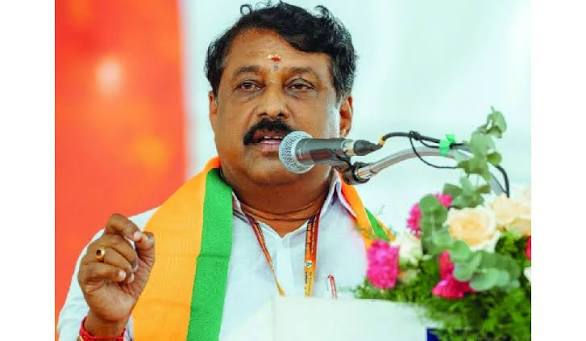
At a podium. Public speaking has been the constant across every phase of the
career — ministerial, legislative and organisational.
IV
The portfolios
His five years in government were not spent in one department. The record shows a
sequence: Transport from 19 May 2001; Electricity from 2 March 2002; Electricity and
Industries together from 10 June 2002; Electricity, Industries and Rural Industries
from 29 August 2002; and then Industries alone, held from 10 June 2002 through to
12 May 2006.
Read together, that sequence describes a minister moved through the state's
infrastructure and production briefs during a period when electricity supply and
industrial investment were both live political questions in Tamil Nadu. Industries
was the longest and most substantial of them.
What this site does not claim
Portfolio dates are documented. Attributing specific policy outcomes to an individual
minister requires evidence that is not reliably available in the public record, so no
such claims are made here. The offices held are stated; the results are left to the
historians and the archives.
The government he served in was led by J. Jayalalithaa and, for part of the term, by
O. Panneerselvam. It ended in May 2006, when the DMK returned to power.
V
Holding Tirunelveli
The decade that followed is the most instructive part of the biography, because it is
the part in which he lost.
In 2006 he was defeated in Tirunelveli by the DMK's N. Malai Raja — 45.42 per
cent against 45.85 per cent. Fewer than half a percentage point separated them. In
2011, with the state swinging back to the AIADMK, he took the seat again with 54.81
per cent against 30.34 per cent for the DMK's A. L. S. Lakshmanan, a decisive win.
In 2016 he lost it again to the same opponent, 42.81 per cent against 43.13 per cent
— another margin of under half a point.
Three elections, two of them decided by fractions of a percentage point, all against
a backdrop of state-wide waves that he could not control. What the sequence
demonstrates is durability: his personal vote in Tirunelveli held between roughly 42
and 55 per cent across a decade in which the party label above his name went from
governing to opposition and back again.
VI
A new party
J. Jayalalithaa died in December 2016. The AIADMK entered a long internal contest,
and its senior figures were, for the first time in decades, genuinely uncertain about
where authority in the party lay.
In August 2017 Nainar Nagendran left the AIADMK and joined the Bharatiya Janata Party.
At that point the BJP's elected presence in Tamil Nadu was negligible; he was the most
senior AIADMK figure to cross over in that period, and the move was reported as a
significant acquisition for a party trying to build a base in the state.
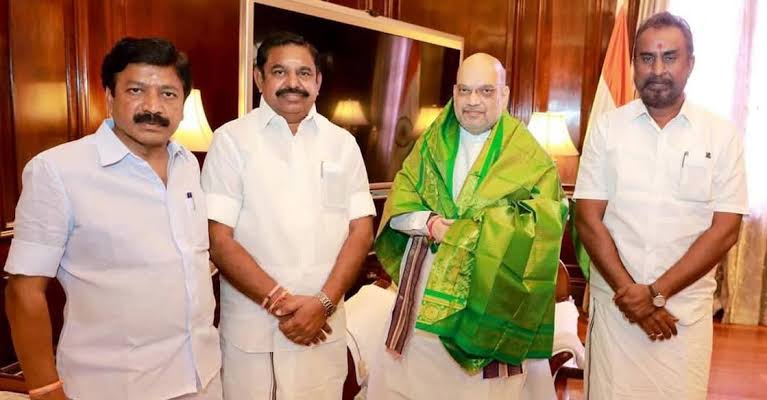
With the AIADMK's Edappadi K. Palaniswami and Union Home Minister Amit Shah.
Alliance politics between the two parties runs through this period of the story.
What followed was steady rather than sudden. He contested the Ramanathapuram Lok
Sabha seat for the BJP in 2019. On 3 July 2020 he was appointed Vice-President of the
party's Tamil Nadu unit. In 2021 he returned to the Assembly from Tirunelveli —
this time on a BJP ticket — with 46.70 per cent of the vote against 35.01 per
cent for A. L. S. Lakshmanan, a margin of 23,107 votes. He was made leader of the
BJP's group in the Legislative Assembly, a position he held through the term. In 2024
he contested the Tirunelveli Lok Sabha constituency.
VII
State President
In April 2025 the BJP announced that it would fight the 2026 Tamil Nadu assembly
election in alliance with the AIADMK. Within days the leadership of the state unit
changed. Nainar Nagendran filed the only nomination for the post of State President
and was elected unopposed on 11 April 2025, taking charge the following day and
succeeding K. Annamalai. His nomination was proposed by Annamalai, by Union Minister
L. Murugan, by the former Union Minister Pon Radhakrishnan and by the legislator
Vanathi Srinivasan.
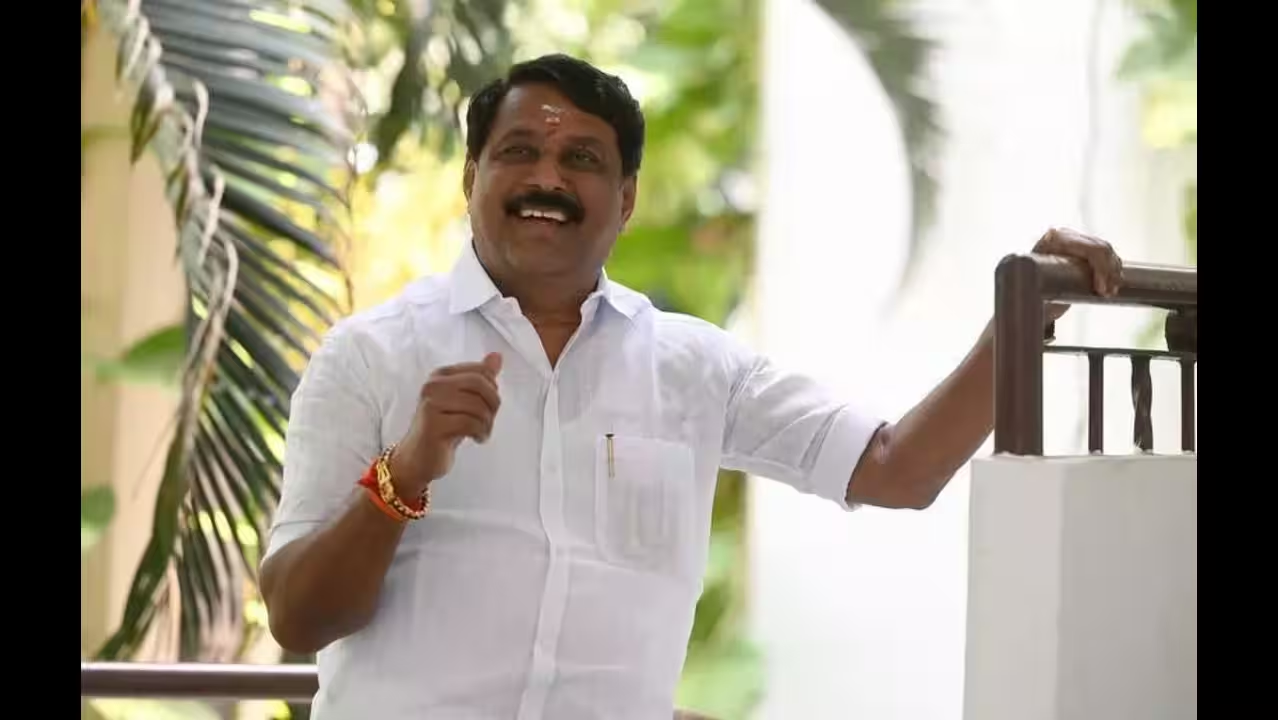
Away from the podium. Photographs of this kind are rare in a political archive
otherwise composed of stages, microphones and delegations.
The year that followed was a campaign year. Polling for the Tamil Nadu Legislative
Assembly was held on 23 April 2026 and votes were counted on 4 May. The BJP contested
27 seats within an NDA led by the AIADMK, with Edappadi K. Palaniswami as the
alliance's chief ministerial face. The alliance did not win. The Tamilaga Vettri
Kazhagam, founded by the actor C. Joseph Vijay, emerged as the largest party, and
Vijay was sworn in as Chief Minister on 10 May 2026. The BJP won one seat.
Nainar Nagendran contested from Sattur, in Virudhunagar district, rather than from
Tirunelveli, and lost to the DMK's A. Kadarkarairaj. Responding to the result, he
said that the party “gracefully accepted” the verdict, that the people had
not given it a mandate to form a government, and that the BJP would not take part in
any effort at government formation.
It is an unfinished chapter, and the honest thing to say about it is that its
significance is not yet settled. What is on the record is a career that has moved
from the executive, through a decade of constituency politics, into the leadership of
a state organisation — and a leader who accepted an adverse verdict in public
and in plain terms.
About this account. Dates, offices, vote shares and margins are drawn
from published election records and established reporting. Passages describing political
context or offering interpretation are written as such and are distinguishable from the
record. No quotation appears on this page that has not been reported in the press, and
no biographical detail has been supplied where the record is silent.