- Home
- Political Journey
Chronology · 2001–2026
The Political Journey
Every contest, every office and every documented transition, in order. Each entry states the period, what happened, the political context around it, and the outcome on record.
The electoral record
Seven contests, three wins
Five assembly elections in Tirunelveli, one in Sattur, and two parliamentary contests. Vote shares below are as reported in published election records.
| Year | Constituency | Party | Vote share | Principal opponent | Result |
|---|---|---|---|---|---|
| 2001 | Tirunelveli | AIADMK | 40.93% | A. L. Subramanian, DMK — 40.24% | Won |
| 2006 | Tirunelveli | AIADMK | 45.42% | N. Malai Raja, DMK — 45.85% | Not elected |
| 2011 | Tirunelveli | AIADMK | 54.81% | A. L. S. Lakshmanan, DMK — 30.34% | Won |
| 2016 | Tirunelveli | AIADMK | 42.81% | A. L. S. Lakshmanan, DMK — 43.13% | Not elected |
| 2021 | Tirunelveli | BJP | 46.70% | A. L. S. Lakshmanan, DMK — 35.01% | Won |
| 2026 | Sattur | BJP | 28.21% | A. Kadarkarairaj, DMK — 31.23% | Not elected |
Scroll the table sideways →
| Year | Constituency | Party | Vote share | Principal opponent | Result |
|---|---|---|---|---|---|
| 2019 | Ramanathapuram | BJP | 32.13% | K. Navaskani, IUML — 44.05% | Not elected |
| 2024 | Tirunelveli | BJP | 31.54% | C. Robert Bruce, INC — 47.06% | Not elected |
Scroll the table sideways →
Percentages are of valid votes polled in the constituency concerned. Where a contest was decided by less than a percentage point — 2006 and 2016 — the closeness is itself part of the record and is discussed below.
Chronology
Twelve entries, in sequence
Read top to bottom. The line beneath each entry separates what is documented from the political context around it.
-
2001
First election, and immediate office
Contested Tirunelveli for the AIADMK and won with 40.93 per cent, a margin of under a percentage point. Sworn in as Minister for Transport on 19 May 2001.
-
2002
Electricity, then Industries
Took charge of Electricity on 2 March 2002. Industries was added on 10 June, and Rural Industries for a period from 29 August. Industries was then held continuously until 12 May 2006.
-
2006
A defeat by fractions
Lost Tirunelveli to the DMK's N. Malai Raja, 45.42 per cent against 45.85 per cent — a gap of less than half a percentage point.
-
2011
A decisive return
Won Tirunelveli with 54.81 per cent against 30.34 per cent for the DMK's A. L. S. Lakshmanan — the largest share he has recorded in any contest.
-
2016
Another narrow loss
Lost Tirunelveli to the same opponent, 42.81 per cent against 43.13 per cent — again a margin of under half a percentage point.
-
2017
Joins the Bharatiya Janata Party
Left the AIADMK and joined the BJP in August 2017 — the most senior AIADMK figure to do so in the period following the death of J. Jayalalithaa in December 2016.
-
2019
Ramanathapuram
Contested the Ramanathapuram Lok Sabha constituency as the BJP candidate, recording 32.13 per cent against 44.05 per cent for K. Navaskani of the IUML.
-
2020
State Vice-President
Appointed Vice-President of the BJP's Tamil Nadu unit on 3 July 2020, a position he held until April 2025.
-
2021
Back to the Assembly, on a new ticket
Won Tirunelveli for the BJP with 46.70 per cent against 35.01 per cent, a margin of 23,107 votes, and was made leader of the party's group in the Legislative Assembly.
-
2024
Tirunelveli, for Parliament
Contested the Tirunelveli Lok Sabha constituency for the BJP, recording 31.54 per cent against 47.06 per cent for C. Robert Bruce of the Indian National Congress.
-
2025
Elected State President
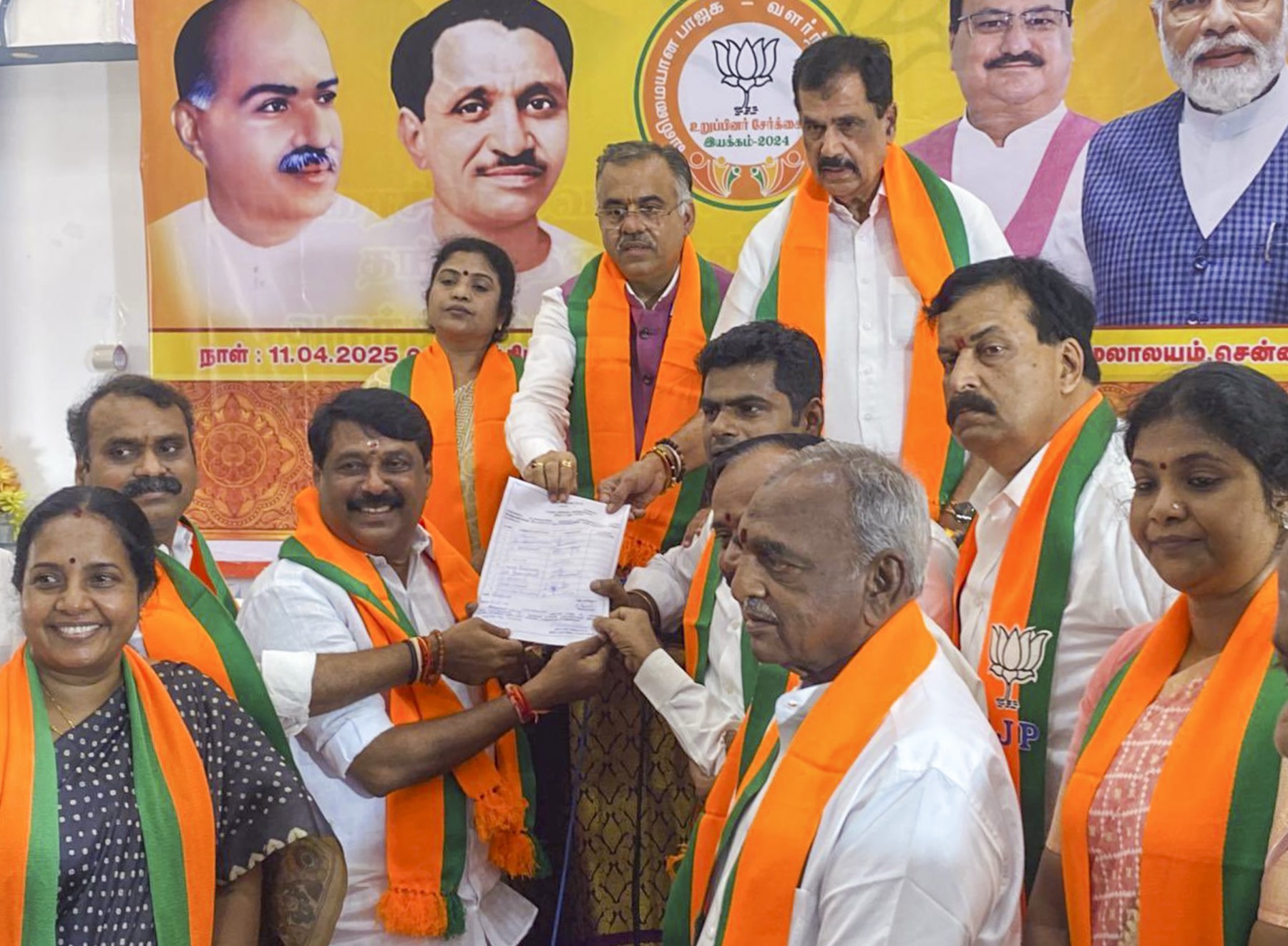
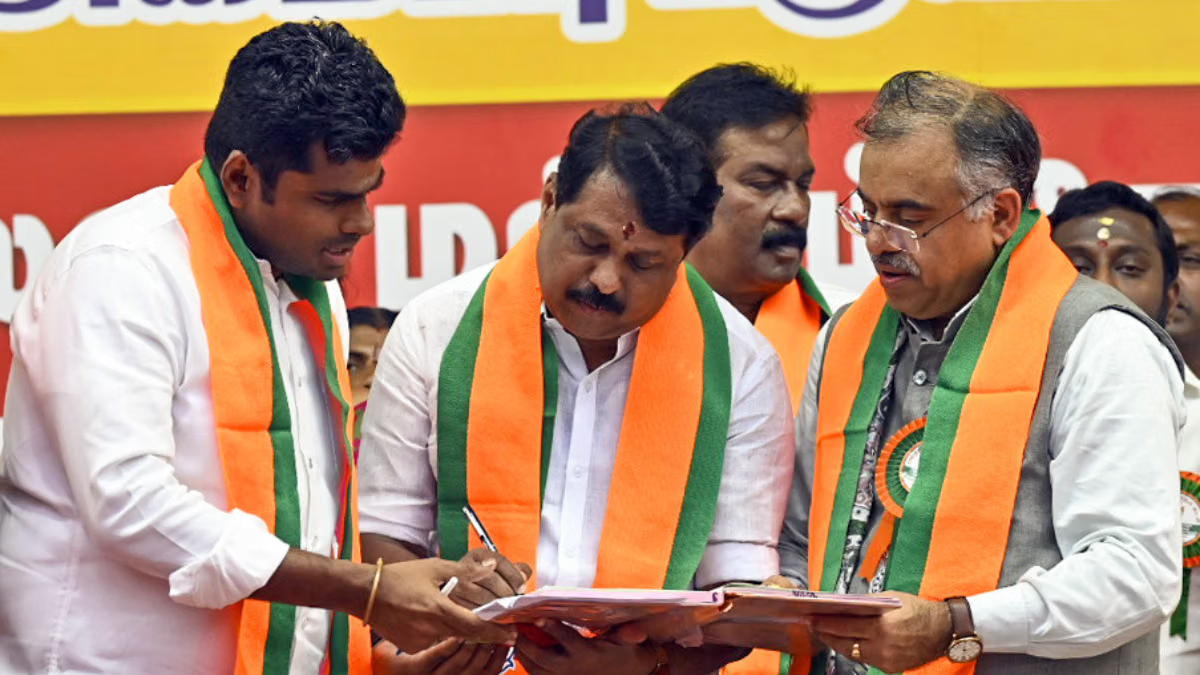
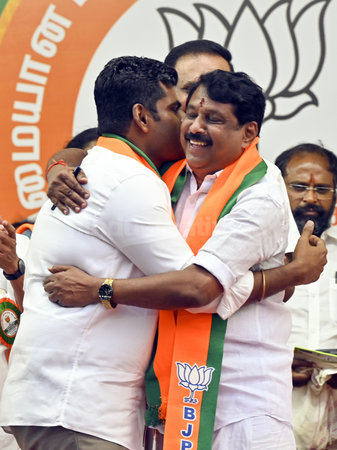
Filed the only nomination for the post of State President of the BJP in Tamil Nadu and was elected unopposed on 11 April 2025, taking charge on 12 April and succeeding K. Annamalai.
-
2026
Sattur, and the state verdict
Contested Sattur, in Virudhunagar district, and was not elected, recording 28.21 per cent against 31.23 per cent for the DMK's A. Kadarkarairaj. Polling was held on 23 April and counting on 4 May 2026.
A closer look
11 April 2025, Chennai
The change of state leadership was a formal, documented process, and it was photographed. Three images from that day and its aftermath.
What the record shows
An uncontested election, formally conducted
Only one nomination was filed for the post. The candidature was proposed by the outgoing state president K. Annamalai, by Union Minister L. Murugan, by the former Union Minister Pon Radhakrishnan and by the legislator Vanathi Srinivasan. The result was announced on 11 April 2025 and charge was taken on 12 April.
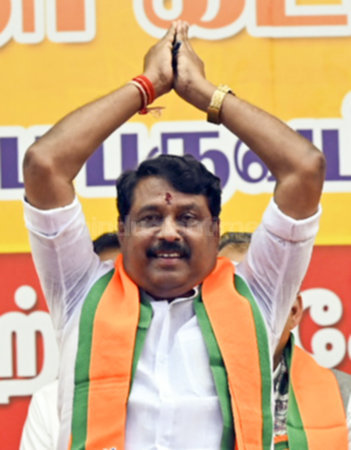
The change followed the announcement, days earlier, that the BJP would contest the 2026 assembly election in alliance with the AIADMK.
Reading the journey
What a chronology like this can and cannot tell you
Set out end to end, the sequence shows a politician whose personal standing in one constituency proved more durable than the fortunes of either party he belonged to. He held or nearly held Tirunelveli through four changes of state government.
It also shows the limits of that standing. Contests fought outside Tirunelveli — Ramanathapuram in 2019, Sattur in 2026 — and contests fought for Parliament rather than the Assembly produced smaller shares. A local vote is not automatically transferable.
What a chronology cannot tell you is why any of it happened. Motive, negotiation and judgement sit outside the record, and this page does not speculate about them.